
Wheat Penny Value: What Determines Its Price Today
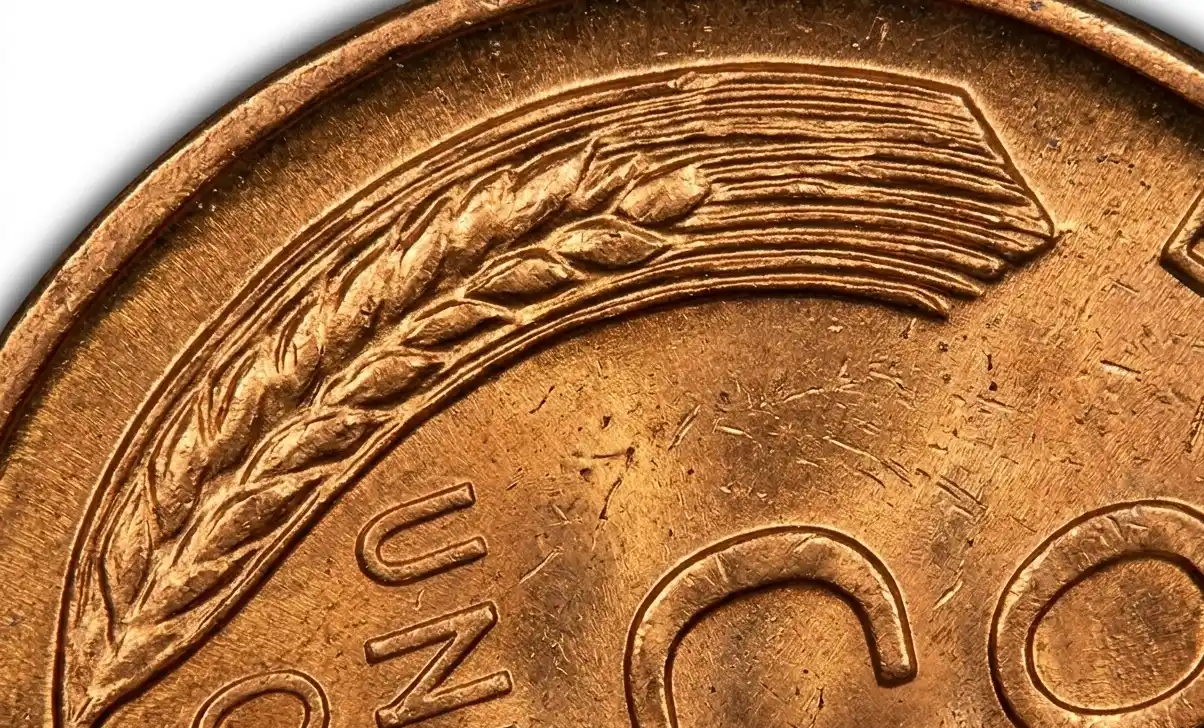
One-cent coins featuring wheat stalks on the reverse circulated in America between 1909 and 1958.
This currency replaced the Indian Head series.
Current market Wheat Penny value ranges from face value to hundreds of thousands of dollars.
Parameter | Value (1909–1942, 1944–1958) | Value (1943, Steel) |
Mass | 3.11 grams | 2.70 grams |
Material Mix | 95% Copper, 5% Tin, and Zinc | Steel with Zinc coating |
Diameter | 19.05 mm | 19.05 mm |
Thickness | 1.52 mm | 1.52 mm |
Edge Type | Plain | Plain |
Using a unified metric system allows for precise authenticity checks through weighing.
Weight deviations exceeding 0.15 grams often point to a fake or heavy wear.
Main Factors Shaping Market Worth
Asset prices fluctuate under the influence of several independent variables.
Mintage scarcity → Limited supply → Increased demand.
Surface preservation → Sheldon scale grading → Price growth.
Production site → Presence or absence of a mint mark → Value difference.
Mint Location Role
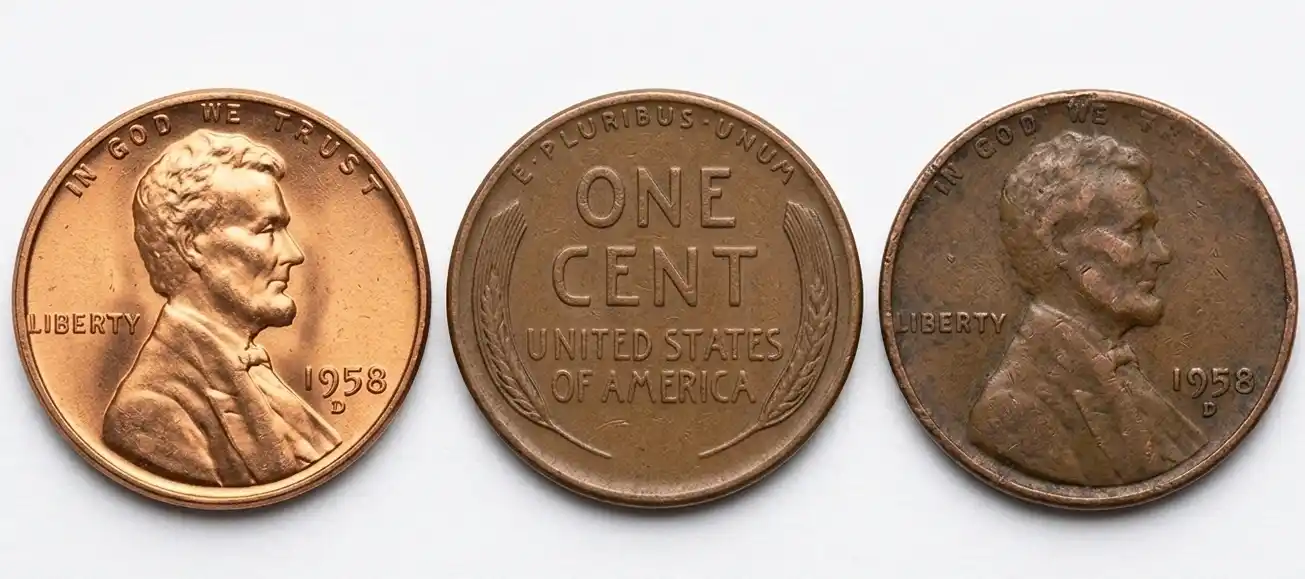
Mint marks sit right under the date on the front side.
Philadelphia produced coins without any mark.
S indicates San Francisco.
D stands for Denver.
San Francisco issues historically had lower production numbers.
Having a lower mintage directly boosts their investment appeal.
Evaluating Condition and Color
Color acts as a critical evaluation factor for Copper coins.
Professional services like the coin appraisal app utilize three distinct grades.
Red RD
Red-Brown RB
Brown BN
Specimens categorized as Red cost significantly more due to keeping their original luster.
Losing the red tint happens because Copper oxidizes when touching oxygen.
Copper Price Trends and Impact on Base Worth
Metal worth creates a price floor for common coins.
2024 price: $0.024 per gram of Copper.
2025 price: $0.028 per gram of Copper.
2026 price: $0.032 per gram of Copper.
Rising material costs force investors to buy even heavily worn pennies in bulk.
Copper scrap value in one coin now exceeds its face value by more than three times.
Rare Dates and Key Issues Analysis
Certain production years demonstrate extremely high prices at auctions.
1909-S VDB
People consider this coin the most recognizable in the series.
The designer's initials on the back were removed shortly after production started.
Mintage reached only 484,000 units.
In 2019, an MS67 Red specimen cost about $110,000.
In 2023, a similar piece sold for $145,000.
Average annual price growth stays at 7.5%.
1914-D
This Denver issue suffers from low survival rates of high-quality pieces.
Most coins stayed in active circulation for decades.
Uncirculated specimens appear extremely rarely.
The auction record for this position exceeds $150,000.
1922 No D
An error occurred because of a clogged die at the Denver Mint.
The letter D completely vanished from the front side.
Three main varieties of this error exist.
Die Pair 2 variety remains the most valuable.
Worth in AU50 condition sits around $2,500.
Worth in MS63 condition exceeds $20,000.
Minting Errors and Their Market Value
Manufacturing defects turn a common cent into a unique collectible item.
Double Die Obverse DDO
A double hub strike creates duplication of design elements.
The 1955 issue remains the most famous.
Shifted date digits and Liberty lettering stay visible to the naked eye.
Price for a specimen in good condition starts from $1,200.
The auction record for an MS65 grade sits above $50,000.
Off Centre
Blank misalignment during the strike results in an incomplete image.
Worth depends on the displacement percentage.
10% shift → $15 price 50% shift with visible date → $100 price 90% shift → $250 price
Keeping the date on a shifted coin is mandatory for a high appraisal.
Repunched Mint Mark RPM
Punching the mint mark twice at different angles creates this variety.
This mostly occurs on 1940s issues.
Value for such specimens varies from $5 to $200.
Novice collectors find this an accessible segment.
1943 Steel Pennies and Their Anomalies
Copper was replaced by galvanized Steel to support front-line needs during World War II.
A regular Steel cent costs between $0.15 and $10, depending on shine.
Major value resides in error specimens struck on Copper blanks.
1943 Copper Penny
A few Copper blanks from 1942 stayed in the bins and met the 1943 dies.
About 40 confirmed specimens exist.
In 2010, one such piece sold for $1,700,000.
In 2021, the price for another specimen reached $840,000.
Checking authenticity is easy using a magnet.
A Copper penny should not be attracted.
A Steel penny sticks instantly.
1944 Steel Penny
The reverse situation happened in 1944.
Remaining Steel blanks were used with the new dies.
Their worth ranges from $75,000 to $110,000.
Finding such a specimen in circulation today is virtually impossible.
Investment Return Table by Decade
Analysis shows steady price growth for rare positions.
Period | Value Growth (Rare Dates) | Value Growth (Common Dates) |
1990–2000 | +45% | +10% |
2000–2010 | +60% | +15% |
2010–2020 | +85% | +25% |
2020–2026 | +30% | +12% |
Investing in coins with MS65 grades or higher shows the best returns.
Liquidity for such assets is provided by Heritage and Stack's Bowers auction houses.
Certification Impact on Final Price
Certification from PCGS or NGC companies acts as the industry standard.
The market views a coin without a slab with suspicion.
Having a plastic holder confirms authenticity.
It also guarantees surface preservation.
The price gap between certified and uncertified coins can reach 300%.
For example, a 1909-S VDB without a certificate costs $700.
The same coin with a VF20 grade from PCGS already costs $1,100.
Detailed Price List for Popular Issues
Data remains current for Very Fine VF condition.
1909 VDB: $12
1909-S: $100
1910-S: $18
1911-S: $45
1912-S: $25
1913-S: $15
1914-S: $22
1915-S: $20
1921-S: $5
1923-S: $8
1924-D: $40
1926-S: $12
1931-S: $75
Prices are listed in US dollars.
Issues after 1934 in worn condition cost between $0.03 and $0.10.
Only coins in perfect condition form an exception.
Demand Structure and Sales Channels
Selling coins occurs through several platforms.
Online auctions → Fast sale → 10–15% commission.
Numismatic shows → Personal contact → Bargaining opportunity.
Private dealers → Instant buyout → Lower purchase price.
Selling rare specimens through major auctions takes up to 6 months.
Cataloging and marketing procedures cause this delay.
Price Changes Depending on Grade (1914-D Example)
A coin's condition critically impacts its Worth.
G4 Good → $175 F12 Fine → $350 VF20 Very Fine → $550 EF40 Extremely Fine → $850 AU50 About Uncirculated → $1,200 MS63 Mint State → $3,500 MS65 Red → $25,000
The gap between AU50 and MS63 is explained by the total lack of circulation signs in higher tiers.
Even a microscopic scratch lowers a coin's class.
This leads to losing thousands of dollars in market value.
How to Avoid Buying Fakes
High Wheat Penny prices stimulate the production of counterfeits.
Most fakes are made using the casting method.
Such coins possess a porous surface.
Lettering on the legend looks blurry — check it with the free coin app.
Special attention should go to the mint marks.
Counterfeiters often solder the letter S onto regular Philadelphia coins.
Studying the seam under a microscope allows for detecting interference.
Fake weight often differs from the standard by more than 5%.
Using precise scales remains a mandatory verification step.
Recent post
Community-Led Conservation Efforts
Climate Change Impact: Understanding The Mediterranean's Shifting Ecosystems
Sustainable Agriculture In The Mediterranean: Innovations And Practices
Revolutionizing Medical Award Verification with AI and Blockchain Technology
Rare Quarters Worth Collecting: Beginner-Friendly Finds and Advanced Key Dates